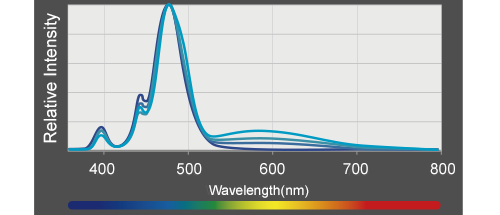
Kessil's A360X draws up to 90 W. It is modelled here with two of its controls, as the Kessil app names them: Intensity and Color. Color moves the whole spectrum between a deep blue and a whiter blue rather than turning channels up and down. Below is its spectrum at full intensity and Color 50, blended from the two ends read from Kessil's own published graph.
Set it in the comparer · PAR on its own page
Peaks near 396, 443 and 476 nm.
Blue 45%, green 22%, royal blue 16%, red 7%, yellow 4%, UV 3% and violet 3% of its power.
No PAR estimate for the Kessil A360X. The published readings found so far are too few to set a low and a high: one owner's pair of A360Xs, with the violet channel on, is not enough to say what one light gives at a known setting.
Spectrum read from Kessil's A360X product page, Spectrum tab (four curves, no scale, no Color labels). See the graph.
Kessil's graph shows four curves and does not say which Color setting each one is. This site reads the bluest as Color 0 and the whitest as Color 100: an assumption, not Kessil's label. The two curves between them are close to a blend of those two ends, off by about 1 to 2% of the peak on average and by up to about 7% at the steepest points of the trace, which is why the slider blends between the ends.
The graph has no scale. Kessil says the light keeps a consistent power output across the Color range, so this site sizes both ends to the same total, the light's 90 W maximum draw. That puts it on one scale with the other lights; it is an assumption, not a measurement of its light output.
Not included: the violet, red and green channels that Kessil's app or Spectral Controller X adds, because Kessil publishes no spectrum for them.
Kessil's own page for it: Kessil A360X.
No PAR estimate for the Kessil A360X. The published readings found so far are too few to set a low and a high: one owner's pair of A360Xs, with the violet channel on, is not enough to say what one light gives at a known setting.
reeffrags.com is not affiliated with or endorsed by Kessil. The graph is theirs; the reading of it, and any error in that reading, is ours.