Magician
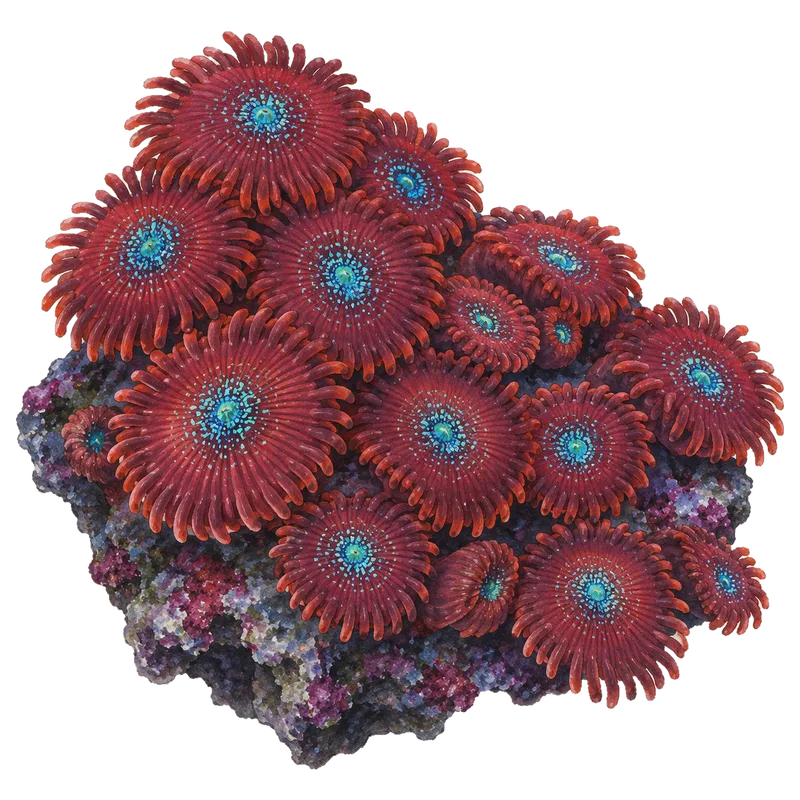
Zoanthus, a zoanthid. Beginner to keep, typical PAR 75–250, moderate to high flow.
Also sold as Magicians, Magician Zoas, Magician Zoanthids, ECC Magician.
A loose trade name. Sellers use it loosely, so trust the photo over the label.
Collector tier: common, where the trade ranks it from common through grail. In stock at 15 surveyed shops on 2026-10-19.
A zoa with teal to blue speckle packed into the centre around the mouth, which is the sparkle the name is about, on a deep red to maroon disc. Shops disagree on the rest: the farm that grows it calls the polyp solid red, another shop calls the disc deep purple to maroon, and one describes it as red striped with purple. Its genus is disputed too: one large retailer lists it as a Zoanthus, while the farm and a coral index call it a Palythoa.
Before you buy one
Judge the centre first: teal or blue speckle there is what six of the seven sources that describe it agree on. Ask for a white-light photo, because blue light makes many red zoas sparkle. Two shops give it a green mouth inside the speckle, and the disc runs from red to purple-maroon between sellers, so a slightly different colony is not proof of a wrong one. Shops also sell a Green, an Ultra and a Red Magician under their own names.
Keeping zoanthids
Low to middle rock, enough flow to keep detritus off the mat. Magician is beginner to keep at a typical PAR of 75–250 in moderate to high flow. A typical starting range for this type of coral, not measured on this one.
What Magician goes for
No verified sales yet. A range publishes once 3 dated, checkable records from 3 different sources exist, priced per polyp and reported as a median, with what shops ask kept separate from what buyers paid. One polyp, so a ten-polyp frag is divided by ten. Listings that do not state the count are dropped rather than assumed. Nothing on this page is for sale. Shops are typically asking $5 to $12 per polyp, median $10, across 15 shops surveyed on 2026-10-19; the full sweep ran $3 to $20. Asking prices are what sellers want, not what buyers paid. On 2026-10-19 it was in stock at 15 surveyed shops: barrierreefaquariums.com, chiefreefcorals.com, coral-insanity.com, coralsanonymous.com, coralscoral.com, coralsofeden.com, and 9 more.
Easily confused with
- Utter Chaos: A speckled purple face too, but speckled white and yellow-green across the whole face around a teal mouth, under a frilly orange skirt.
- Pink Zipper: A speckled dark face too, but pink speckle over dark purple around a small green mouth, with a plum skirt tipped teal.
- Fire and Ice: A blue centre too, but on a steel-blue disc under a rust-orange to red skirt.