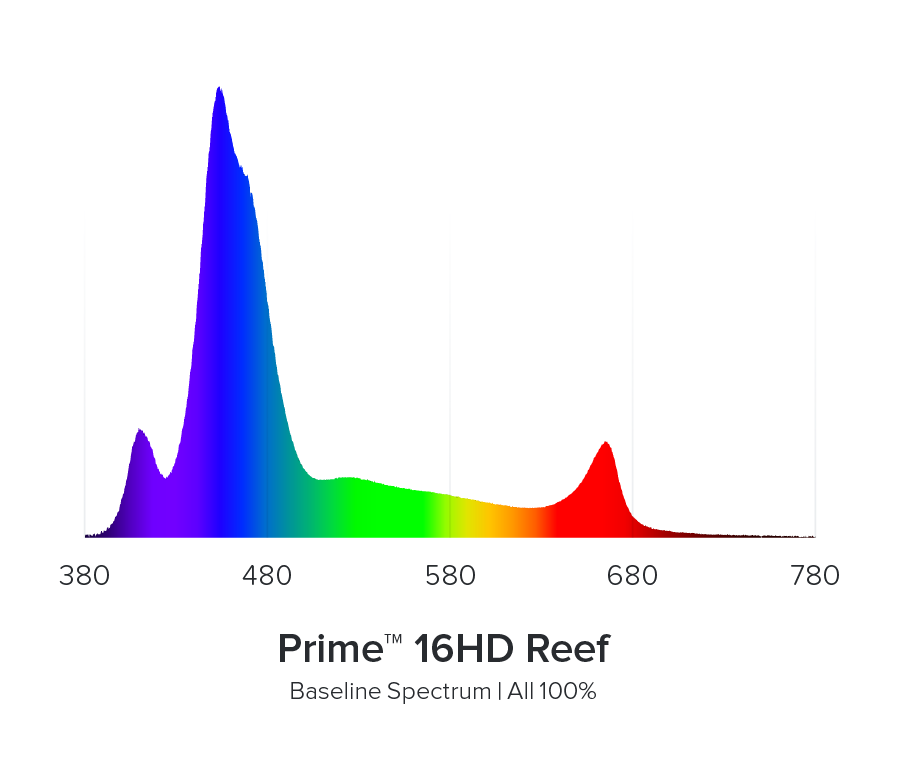
AquaIllumination's AI Prime 16HD draws up to 59 W across 8 channels, named here as myAI names them: UV, Violet, Royal, Blue, Green, Red, Moonlight and Cool White. Below is its spectrum with every channel at 100%, read from AquaIllumination's own published graph.
Set its channels in the comparer
Peaks near 410, 453 and 665 nm.
Blue 29%, royal blue 29%, green 14%, red 13%, violet 8%, yellow 6% and UV 1% of its power.
With JavaScript on, type the light's height above the water and the coral's depth and the page works out a range.
This is an estimate built from a few hobbyists' readings, not a measurement. The range is wide on purpose, because those readings disagree, for some lights by nearly two times, and one owner's corals burned at a step the low end called small. It is for the spot right under the light; anywhere off to the side reads lower. A PAR meter reading beats it every time. PAR here is in µmol per square metre per second, the unit a PAR meter reads.
Spectrum read from AquaIllumination Prime product page, graph 'Prime 16HD Reef, Baseline Spectrum | All 100%'. See the graph. The split between channels is a model fitted to that graph. Added together, its channels match the graph closely (R² 0.999), which shows the total fits; it can't show each channel is right.
myAI's HD mode lets a channel run above 100% when others are turned down; the app's sliders stop at 100%.
AquaIllumination's own pages give 55 and 59 W; the app uses the spec table's 59 W.
AquaIllumination's own page for it: AI Prime 16HD.
Where its PAR range comes from: DaniReef LAB's readings of a Hydra 32 HD, which is two of the Prime's 16-LED clusters behind the same 80 degree optics: every channel at 100%, 1949 PAR at 17 cm, 473 at 37 cm, 206 at 57 cm (Apogee MQ-510, in air, corrected). AquaIllumination's own figure for the Prime, 100 PAR at 24 in, gives the low end.
reeffrags.com is not affiliated with or endorsed by AquaIllumination. The graph is theirs; the reading of it, and any error in that reading, is ours.